Showing posts with label Native Plants. Show all posts

Friday, June 19, 2015

Summer Beauties

Summer in the subtropics can be very hot and humid for humans but for most plants acclimated to this climate, it is very comfortable. Along with longer, warmer days, we have been getting consistent rainfall, both of which have helped many of our plants put on new growth and become reproductively active. The Gardens are full of life, colors, textures and interesting structures.


One of the highlights of our collection right now is Cycas micronesica with its first flush of female strobili (cone-like structures). If you have taken my TYUP™ tour, you know all about cycads and their prehistoric past. Now we need a male plant so the pollen from the male strobili can fertilize the ovules in the female strobili and we can get seeds. Despite our lack of a male plant, we may be able to obtain pollen from Montgomery Botanical Center (MBC) in Coral Gables and fertilize the ovules by hand. MBC has a collection of stored pollen from some of their cycads and since our plant came from them, we may well find a match.
 
Cycas micronesica

A female strobilus similar to a (pine)cone

Note the small green ovules inside the 'cone' scales.

After at least one month of waiting for the flower buds to open, we have finally been rewarded with the fragrant blossoms of Jacquinia keyensis or Joewood (primrose family, Primulaceae). This is one of my favorite plants since the flowers are slightly unusual; the outer whorl of stamens are actually well-developed staminodes that resemble petals (see photo below). The fragrance from these blossoms is exquisite and smells like gardenia with a hint of ylang-ylang. The flowers are already fading but will hopefully produce copious amounts of fruit since I want to grow them from seed. Native to the Florida Keys and south Florida, it grows in habitats between the low-lying mangrove forest and the more upland hardwood hammock so it’s right at home along our bayfront.
 
Jacquinia keyensis in full bloom (close your eyes and inhale the perfume from the flowers!)

Floral anatomy of Jacquinia keyensis

We have a closely related cousin to joewood that is a new arrival to the Gardens: Clavija domingensis, otherwise known as Langue de boeuf or beef tongue plant due to the leaves’ resemblance to a long bovine tongue. This plant is native to the Dominican Republic and will eventually be a very interesting specimen once it grows up a bit. After one week of being in the ground it already flushed out a new set of leaves. Two of its Dominican associates are planted nearby, the zombie palm, Zombia antillarum and 2 new Dominican cherry palms, Pseudophoenix ekmanii, which are critically endangered in the wild.


Clavija domingensis or beef tongue plant from the Dominican Republic with its new flush of leaves.
Pseudophoenix ekmanii, Dominican cherry palms, in the wild they are over-harvested for their sap which is used to make palm wine.

Another fragrant favorite is Plumeria sp. or frangipani and all of our trees are in full bloom. Guests recently strung their own lei! You can see the photos on our Facebook timeline.


The little fledgling doves appreciate the canopy of our white Plumeria alba.

At Robert Is Here tropical fruit stand in Florida City, they sell mangrove honey and you may think, "What? I've never seen a mangrove flower." Well, here they are in all their loveliness...
Flowers of the red mangrove, Rhizophora mangle, are often overlooked but they are quite elaborate on close inspection.
Here are the flowers of the black mangrove, Avicennia germinans, which, although small, are very fragrant.

For more photos on what is blooming at the Gardens right now, see our Facebook page for photo albums.

Emily B. Magnaghi
Associate Director

Sunday, February 22, 2015

Reclaim and Restore

Our human footprints are found all over the world, in every habitat on each and every continent. Areas that we consider truly wild have the faintest imprint of humans on them, but there is no where on this planet that is untouched and pristine. We are everywhere because we are part of nature and have successfully spread around the world colonizing every habitat. Now, in order to escape our built environment that seems so far removed from nature, it seems we must travel long distances to seek out solitude.

Mt. Banner and Thousand Island Lake in the Ansel Adams Wilderness Area - Inyo National Forest, California
Wilderness is an area that we crown with this title. According to The Wilderness Society, ‘Wilderness is a type of protection given to the most pristine wildlands - areas within national parks, forests, recreation areas and other wildlands where there are no roads or development”. Webster’s Dictionary defines wilderness as, “a wild and natural area in which few people live”; but there are still people, if even only a few. In order to obtain a sense of wilderness and peace in nature, to maintain habitat for other species to coexist with us, we must now restore areas we have degraded through human industrial activities. In order to protect our urban habitats from storms, which are becoming fiercer and more frequent, we must build our environment as close to a natural system as possible so that it will withstand the strong winds and waves that come with each passing storm and help protect our homes and businesses from damage.


Damage along the New Jersey shore from Superstorm Sandy in 2012. Without a natural buffer of barrier islands, these coastal habitations were flooded and many of them uninhabitable after the storm. (Photo by U.S. Air Force)
Restoration is the act of returning something to its original condition by repairing it. This can happen naturally in areas that are adjacent to intact, undegraded habitat where there are plants nearby to supply seeds for regrowth. Over time, seeds will drift in or be carried in by animals allowing plants to regain a foothold, or rather, a roothold. Terrific examples of this abound: Pripyat, the town near Chernobyl, and areas of cities like Detroit where after decades of being abandoned, plants and trees have sprung up through the old buildings and factories to reclaim the land; and right here in North Key Largo, where the land was scraped and leveled for agriculture then cleared for housing developments that were never built and has now returned to hardwood hammock, complete with several endangered species that are under Federal and State protection.

The ghost town of Pripyat in Ukraine (Photo by Gerd Ludwig for National Geographic)
A cabin succumbing to the hardwood hammock in North Key Largo
An endangered Key Largo Woodrat (Neotoma floridana smalli) nest in the base of the trees' roots. This area was likely a key lime orchard in the 1940s and has naturally returned to hardwood hammock over the years. Due to the alteration of the topography, land managers must now create artificial nests for the woodrats. This nest was created by power washing the bases of the trees to create an underground living quarter.
Plants are highly adaptable, especially here in a hurricane zone. Coastal plants around the world in subtropical to tropical latitudes have evolved with tropical cyclones (hurricanes are one type of cyclone) and all the chaos that comes with them: pounding rain, high winds and flooding from storm surges. Right here in our Gardens, a native Sea-grape tree (Coccoloba uvifera) at the beach was blown over and nearly uprooted by Hurricane Wilma in 2005 but has resprouted and is a stunning shrub. We also have a stubborn little fire bush (Hamelia patens) in our parking area that has made a coral rock its home for a quarter of a century! Designing our future shorelines and barrier islands for storm protection really hit home after Hurricanes Katrina in 2005 and most recently Sandy in 2012. Many municipalities are looking to innovative green building designs coupled with restoring marshes and beaches with locally adapted native plants for their resilience and tenacity in the face of these storms.
Coccoloba uvifera - Sea-grape tree that was nearly uprooted during Hurricane Wilma in 2005 is thriving once again
Restoration can also be facilitated by us, think of gardening on a landscape level with bulldozers recontouring the land and native plants repopulating the landscape. Seeds are collected and either grown out in a nursery or directly seeded across the landscape to reintroduce the local native flora back onto the site. This type of restoration must be done when the degree of disturbance is high, such as with mining operations and other large-scale land disturbances like landslides and hurricanes. It may also be useful in brownfields and abandoned agricultural areas. 


Genesee Coal Mine & Power Plant in Alberta, Canada- Reclamation projects have been in place since 1990, returning mined lands to agricultural use and wildlife habitat. 
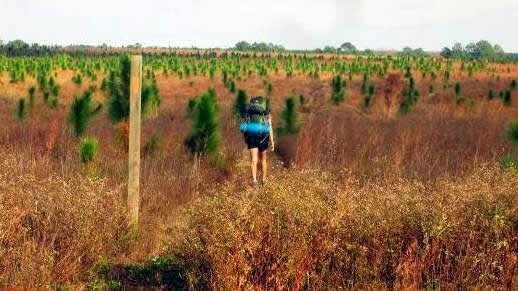
The largest restoration project east of the Mississippi River is in North Florida on the 51,000-acre Nokuse Plantation. This formerly neglected land is being turned back into longleaf pine forest (Pinus palustris), of which only 3% remains in the southeast United States. By repairing our damaged landscapes, we may bring a bit of wilderness back into our lives, right in our own backyards and cities. Wilderness does not need to be an out-of-the-way, untouchable resource that only a few hardy individuals can make the trek to experience.

A hiker along the Florida National Scenic Trail heading into Nokuse Plantation longleaf pine forest
If we are fortunate enough to live near a national park or forest, a wild and scenic river, a state or county park, or even undeveloped land, we can experience that sense of wonder and place in nature. These parks may also provide an outlet for volunteering on restoration projects. For several years I worked in the Presidio of San Francisco where they have a community-supported restoration program. The Presidio is a former military post and over the last 2 decades it has been managed for restoration of its natural areas, to minimize landfills deposited by the U.S. Army and to help preserve its habitats for rare plants, insects, birds, and mammals. The convenience of the park being within the city limits of San Francisco encourages many citizens to come out and lend a hand in restoration activities. After heavy equipment hauls out the remains of landfills and recontours the slopes of the sand dunes and bluffs, crews of volunteers and school groups come out to assist with the restoration efforts. Needless to say, parts of the park have been transformed back into wilderness areas with coyote and gray fox prowling amongst the rare wildflowers on the dunes once again. If you plant it, they will come!

1601077_947092301970593_489434899420269090_n.jpg
Our wildlife ecologist managed to snap a picture of a rare sighting of a grey fox! The last record of a grey fox sighting in the Presidio was in 2004. The fox scrambled onto some branches along with a raven as a coyote prowled around a bush below. Thanks to Jon Young for the incredible picture! (Feb. 2015)
No matter where you live, you can rewild your yard by planting native plants or becoming involved with an organization in your community that is restoring a local natural area. Being out in nature is beneficial to our spirit and mind and experiencing a restoration project adds an extra layer of care for the earth; we become personally invested in our natural areas. It is a great way to learn the local flora and fauna and connect with other community members. We can all contribute to creating wilderness a little closer to home. As David Byrne said in his 1988 hit (Nothing But) Flowers, "Once there were parking lots, now it's a peaceful oasis".

Emily B. Magnaghi
Associate Director

Wednesday, February 4, 2015

Spring-Cleaning in the Nursery

While we do not exactly have a spring season in south Florida, I use the common phrase “spring-cleaning” to denote this particular activity. I initiated an effort to clean out some of the weedy and invasive species that we have growing in our nursery and shade house. We have very limited nursery space to grow seedlings, cuttings and pups from some of our collections, therefore space is at a premium. Last month we obtained new plant specimens from nearby Fairchild Tropical Botanic Garden and last week we received several new arrivals from Montgomery Botanical Center. While we finalize garden planning on where to place these specimens, they may wait in the nursery area for several weeks before being out-planted. By cleaning out the nursery and taking stock of what we have, we can make space for new arrivals, focus on keeping plants healthy, and most importantly, remove invasive species.

I realized that we had several plants that are considered invasive species in south Florida and the Keys, while doing an inventory of our nursery stock. This issue is important to me since I have worked on the land management side of botany and seen what havoc invasive species can wreck on the environment, not to mention the hours spent removing the pests and the amount of tax-payer dollars spent trying, in vain, to control these weeds. While oftentimes these plants are beautiful, if they make it out of gardens and into our natural areas, they become invasive and threaten our native, south Florida species, many of which are already rare. Our Gardens are about 0.5 miles from the nearest natural area to which birds could potentially spread seeds. By having these plant species in our Gardens, visitors may be inspired by their beauty and possibly plant them at their homes, spreading the problem further afield. I would like to inspire people to plant native plants and non-invasive exotic plants. By eliminating the potentially invasive species from our Gardens, we can rest assured.

Among the plants we have removed from our nursery so far are wart fern (Microsorum scolopendrium) and Asian sword fern (Nephrolepis brownii), tropical almond tree (Terminalia catappa), Mexican fan palm (Washingtonia robusta), and cardboard palm (Zamia furfuracea – a cycad). We have begun removing fountain and napier grasses (Pennisetum setaceum/ P. purpureum) from our landscape and are replacing them with native grasses. There are a few specimens of other invasive exotics in the Gardens that we are grappling with: strawberry tree in our fruit garden (Muntingia calabura), arrowhead vine (Syngonium angustatum) climbing up a palm trunk, Governor’s plum (Flacourtia indica) & Brazilian pepper (Schinus terebinthifolius) providing privacy along a property line and actually rooted on the adjacent property, and foundation plantings of Queensland umbrella tree (Schefflera actinophylla) that provide shade and block road noise for guests and have been on the property for over 20 years.
Removing plants from the nursery is one thing, but how do we deal with these mature plants in the ground? To remove a Schefflera is a huge task with a high price tag, and with nothing large enough to fill its place, would leave a gaping hole. When is having a specimen that you can educate the public with more beneficial than removing it? These are some of the tough decisions that botanic gardens must make when potentially invasive species are part of our collections.

Cardboard palm (Zamia furfuracea) ready to be composted. This species has been added to the Florida Keys list of invasive plants due to its tendency to spread from the landscape into natural areas by seed dispersal. It pops up all over our Gardens from existing plantings which we are working on replacing.
A Tropical almond (Terminalia catappa) sapling on its way out. Seedlings of this species pop up throughout the Gardens even though the mature tree was cut down years ago. New seeds may arrive in mulch deliveries, as well.

Wart fern (Microsorum scolopendrium) that has escaped its nursery pot and started to grow along the ground. Watchful botanists in Miami Dade county are adding this plant to the state invasive species list as it is showing up in natural areas. It is not yet invasive in the Keys, and in fact may not become invasive down here since we have a drier climate, but we have many visitors from the metro Miami area and do not want to encourage them to plant this fern.

Asian sword fern (Nephrolepis brownii) specimen. This species is listed as invasive for Central and South Florida and is invading hammocks in the FL Keys. It is also invading nearby pots in the orchid house (see photo below). Ferns can be particularly tricky due to the multitude of spores they release. The Old World climbing fern and Japanese climbing fern (Lygodium microphyllum, L. japonicum) are both major problems in Florida and in several other southeastern states. Since its introduction in the 1960s, Old World climbing fern now covers 50,000 acres of habitat in Florida, literally climbing over every other plant in its path.  

Small sporophyte of Asian sword fern growing in adjacent pots.

On the flip side, botanic gardens may be some of the first places that a new species’ invasive potential becomes known, or a new pest becomes evident. It is then our obligation to spread the word and inform the local extension service and regulatory committees of the threat. Having staff members that are part of a local invasive plant watch group is helpful to stay abreast of developing issues in your surrounding area. It is our duty as botanical gardens to educate the public about these issues and promote the sale and use of local native plants and non-invasive exotic plants.


In the Florida Keys, our local eradication network is called the Florida Keys Invasive Exotics Task Force. This group includes local, state, and federal agencies and non-profit and public utility personnel who are responsible for removing invasive plants from local natural areas like state and county parks. By working with this group and others like it in south Florida (Everglades Cooperative Invasive Species Management Area & Florida Exotic Pest Plant Council) I am able to stay informed and help prevent the spread of invasive exotic species. Publications such as the AlterNatives Plant Guide are a great way to share local knowledge on landscaping and gardening with the public. 

Emily B. Magnaghi
Associate Director

Thursday, January 1, 2015

Grateful Guests and TYUP Attendees to Finish 2014

Small spaces are the rage these days. It seems that every gardening and architecture magazine has featured innovative ways to design and be comfortable in small spaces; from using raised beds and vertical gardening techniques to repurposing items like shipping containers into homes. Stores like IKEA have made huge headway into American markets and while promoting our seemingly endless desire for goods, have also shown us ways to do more with less, capitalizing on this European tradition.

And that is exactly what we do here at the Botanic Gardens at Kona Kai Resort!

When I first visited the Gardens last spring, I was very curious how they were laid out on less than 2 acres of property. Coming from a larger botanical garden (at the time I was fresh out of 83 acre Fairchild Tropical Botanic Garden in Coral Gables) I was used to sprawling grounds and long rambles between the collections looking for plants. There is even a tram tour to give visitors an overview of the entire property! While that garden is extensive and beautiful, our Gardens are also beautiful, packed with variety and easy to navigate during our botanist-led TYUP* tour.

During Christmas week, I had a family of 10 book my TYUP and they were delighted at how many plants we have in our Gardens. The patriarch of the family, a long-time volunteer at Fairchild, commented that our collections were very easy to see during the tour and that some of our plants, our cycads in particular, looked very healthy and happy. I was shining with pride! What a great compliment to end the year with.

We do our best to have a good diversity of plants with the limited space we have to work with – remember we are part of a resort and the buildings take up real estate. However, we have managed to collect over 360 plant species, cultivars and hybrids including 25 edible tropical fruits, over 20 Florida Keys natives, 38 species of palms, and 15 bamboo specimens. Not bad for less than 2 acres! We are busy adding more this year so come down to visit and see for yourself how we maximize our space.

*Transforming Your Understanding of Plants tour – see this blog here.

Dioon mejiae, Honduran dioon, a cycad native to Honduras and Nicaragua [Zamiaceae]

Annona squamosa, sugar-apple, a fruit of the tropical Americas and West Indies [Annonaceae]

Byrsonima lucida, Locustberry, a south Florida native [Malpighiaceae]